
Location as a Career Catalyst: Why NJIT’s CEE Graduate Programs Put You at the Center of Opportunity
January 14, 2026 by njitadmin
Choosing where to pursue your graduate degree isn’t just about academics, it’s about access to industry, innovation and opportunity. At NJIT’s Department of Civil & Environmental Engineering (CEE), location is a powerful differentiator.
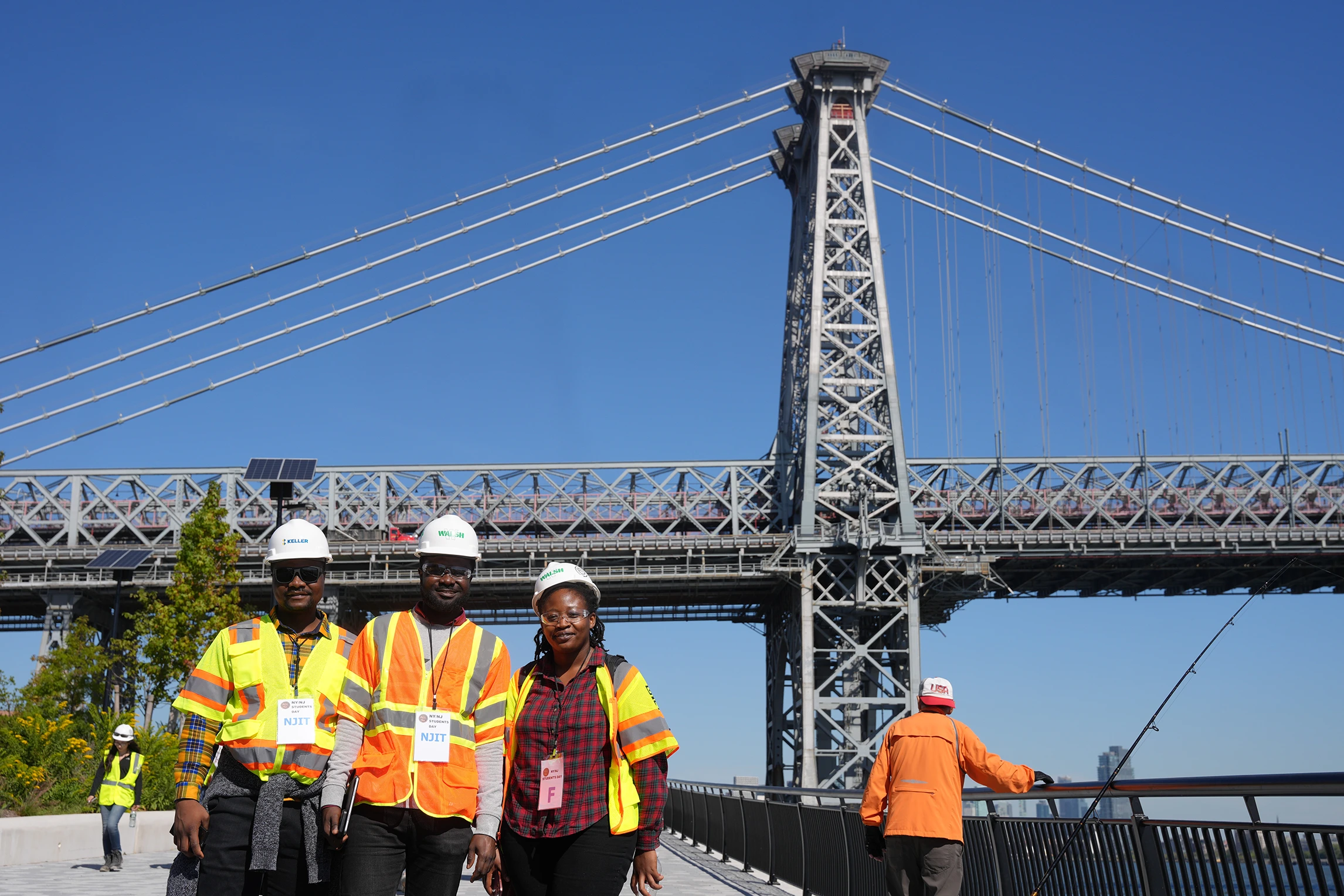
Based in Newark and seamlessly integrated into the New York metropolitan area, NJIT’s CEE places you inside one of the world’s most advanced hubs for infrastructure development, sustainable engineering and smart city innovation. Here, graduate education isn’t abstract—it’s lived and practiced in real time alongside the projects, employers and networks shaping the future of the built environment.
A Living Laboratory
When you study on campus at NJIT’s Department of CEE, you’re immersed in a living laboratory. The New York metro region is a proving ground for today’s most pressing engineering challenges:
- Bridge and tunnel modernization projects are redefining structural engineering.
- Climate-resilient design initiatives are tackling sea-level rise and extreme weather.
- Sustainable water systems are being engineered to secure safe, clean resources for millions.
- Smart mobility and transit innovations are reshaping how a megaregion moves.
From your vantage point in Newark, you don’t just study these problems—you observe them unfolding around you. Assets like Newark Liberty International Airport, Port Newark and NJ Transit/PATH rail systems put you in direct contact with complex, interconnected infrastructure systems.
Physically being in this region also means face-to-face engagement with leading employers like the Port Authority of NJ & NY, MTA, AECOM, Turner Construction and Skanska. These are the organizations students interact with through internships, research collaborations and career fairs right on campus.
Add in strong American Society of Civil Engineers networks and a large, influential alumni community and NJIT gives you both the knowledge and the connections to step into the engineering workforce with confidence.
Graduate Programs Align with Regional Impact
At NJIT, CEE graduate programs are deliberately designed to match the demands of the New York metropolitan area, one of the most complex and innovative engineering markets in the world.
- MS in Civil Engineering: Concentrations in structural, transportation, geotechnical, environmental engineering and construction management prepare graduates to lead projects in bridge modernization, resilient infrastructure and transit expansion.
- MS in Transportation: Focused on planning, design and operations, this program equips graduates to address traffic congestion, smart mobility systems and sustainable urban transportation networks.
- MS in Critical Infrastructure Systems: Emphasizes resilience, security and risk management across essential systems such as energy, water and communications—skills urgently needed to safeguard metro-area communities and economies.
- MS in Environmental Engineering: Tracks in Water Quality & Treatment and Integrated Site Remediation align directly with urgent regional needs for clean water, remediation and climate adaptation.
These degrees are available on campus with flexible evening schedules—perfect for working professionals in the metro region who want to advance their careers while staying connected to local industry.
Graduate Certificates: Fast, Focused Credentials
In addition to master’s programs, NJIT’s CEE offers specialized graduate certificates that deliver targeted expertise in fields shaping the region’s future:
- Climate Change Adaptation & Resilience
- Hydrology & Water Resources
- Structural Engineering
- Intelligent Transportation Systems
- Construction Management
- Environmental Engineering
- Geotechnical Engineering
- Transportation Studies
These programs are highly valued in the New York metro labor market, where employers seek practical, specialized skill sets. Certificates can also be stacked toward a master’s degree, giving students flexibility while keeping their credentials immediately relevant.
Why On-Campus Programs Matter
In a digital age, you might ask: Why study on campus when online options exist? For engineers, the answer is simple: location is experience.
- On-campus students gain immersive exposure to regional infrastructure, from site visits to Newark Airport expansion projects to field-based research at urban resilience initiatives.
- In-person networking with employers and alumni builds lasting professional relationships that virtual platforms can’t fully replicate.
- Proximity to real projects means the case studies in your courses mirror the bridges, tunnels and transit systems you see daily.
- Access to NJIT labs and facilities—like the Smart Connected Infrastructure Systems (SCIIS) Lab—provides hands-on training in IoT, robotics and machine learning applications for infrastructure.
Studying on campus at NJIT’s CEE gives students a competitive advantage: you’re not just learning engineering; you’re practicing it in the very environment where your career will develop.
Career-Defining Opportunities in the Region
Studying at NJIT’s Newark campus ensures direct access to career-building pipelines:
- Partnerships with NJDOT, the Port Authority and the U.S. Army Corps of Engineers create internship and co-op opportunities tied to active projects.
- NJIT’s Career Development Services hosts career fairs that bring hundreds of employers to campus, making job-seeking a local event.
- In 2023, NJIT students secured 873 paid internships and co-ops, generating more than $6.8 million in earnings while gaining practical experience.
Alumni Impact: Real-World Leadership
NJIT CEE alumni turn their graduate education into leadership roles across the metro area:
- Áine O’Dwyer, P.E. (BS ’07, MS ’08) – Principal & CEO of Enovate Engineering; leads public/private sector construction, engineering and project management; serves on multiple boards including NJIT CEE’s Industrial Advisory Board.
- Rafal Wojcik, P.E. (BS ’11, MS ’15) – Geotechnical Project Manager with Dewberry; leads design and foundation work for critical infrastructure including transportation, storm hardening/coastal resiliency and waterfront protection; also serves in leadership roles in ASCE and teaches part-time at NJIT.
- Mohab Hussein, P.E. (MS ’23) – Integrating geotechnical engineering and data science into state-level infrastructure improvements.
These alumni stories demonstrate how NJIT’s location and programs directly translate into professional impact in one of the most competitive engineering markets in the world.
Hands-On Learning and Mentorship
On-campus learning means personal engagement with alumni and industry leaders who stay connected to NJIT:
- Mentorship: Alumni regularly return as mentors, helping students bridge the gap between academic study and professional practice.
- Capstone partnerships: Firms like AECOM, Parsons Brinckerhoff and HNTB serve as real-world clients in capstone projects, posing authentic engineering challenges.
- Guest lectures: Industry experts bring insights from current projects, giving students a window into evolving practices and innovations.
- Networking pipelines: These connections often lead to internships, research collaborations and full-time jobs with the region’s top employers.
Innovation, Research and Community Impact
At NJIT’s CEE Department, research translates directly into solutions for today’s infrastructure challenges. Faculty-led projects such as Professor Matthew Bandelt’s work on resilient concrete and Professor Michel Boufadel’s studies on oil spill remediation showcase how NJIT engineers are advancing sustainable materials and environmental protection.
Closer to home, initiatives like smart urban corridor deployment and lead service line replacement in Newark highlight the department’s role in solving city-scale problems that impact everyday lives.
By combining faculty expertise with student engagement, NJIT’s CEE Department not only pushes the boundaries of engineering research but also strengthens communities locally and globally.
NJIT’s Department of CEE: Where Education Meets Industry
You don’t just earn a credential at NJIT’s Department of CEE, you join a graduate program rooted in one of the most dynamic engineering markets in the world. By studying on campus, you gain access to live projects, direct employer engagement and mentorship that can’t be replicated online.
Advance your expertise with NJIT CEE master’s degrees and graduate certificates. Join a community where education meets real-world infrastructure impact.
Don’t just study engineering. Shape it. Lead it. Build it.
Apply to NJIT’s CEE graduate program today and start building the future you’ve imagined.