
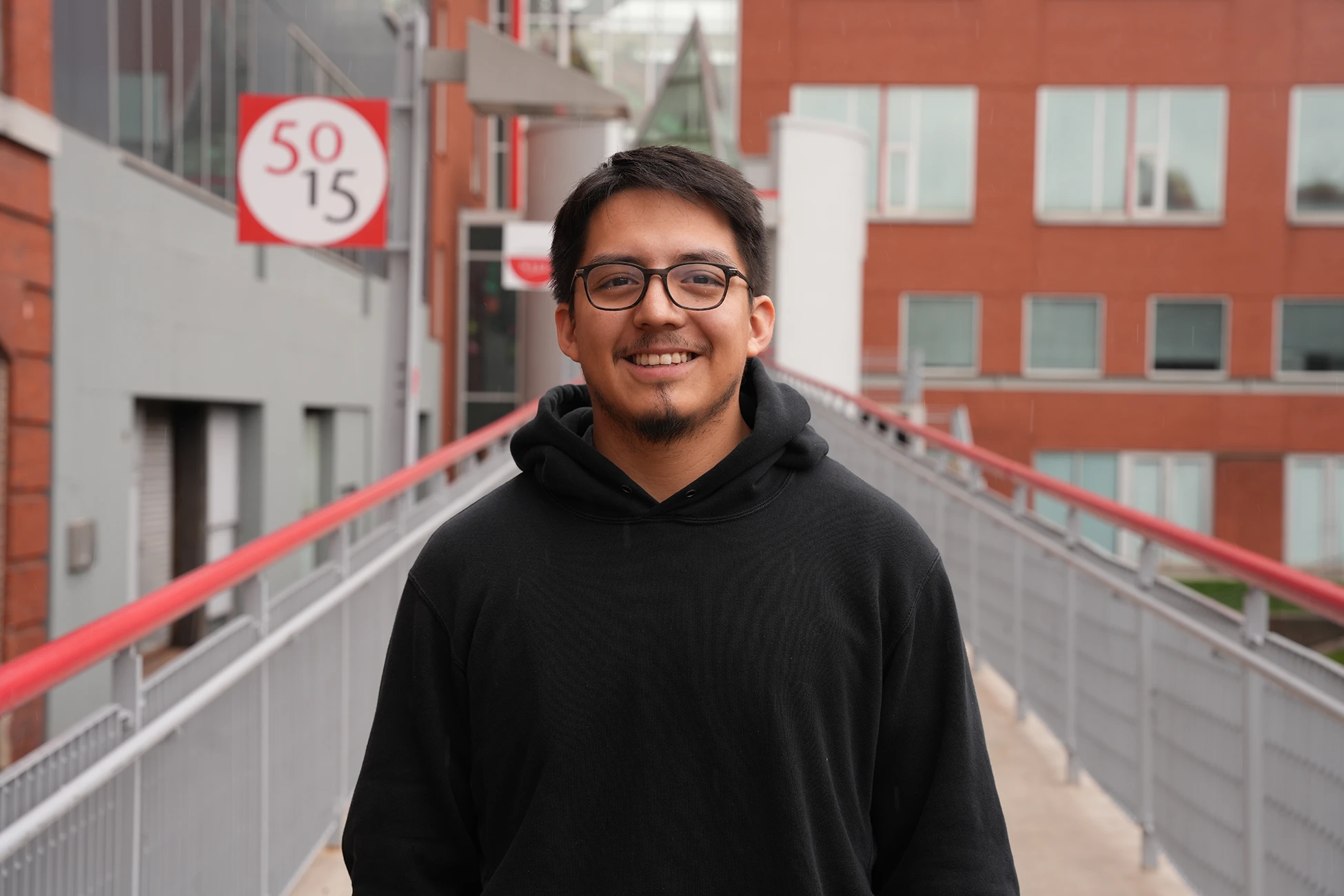
NJIT’s Civil and Environmental Engineering Program Makes Community Builders
January 14, 2026 by njitadmin
How hands-on learning helped CEE master’s student Christopher Lema make an impact—on campus, in Newark and in NYC
Before Christopher Lema stepped onto a job site in Manhattan, he was working in quieter spaces much farther away, overseeing landscaping projects at a seminary in Colorado and doing mission work across Nebraska and Pennsylvania.
The work wasn’t architecture or engineering. But it was the kind he liked most—focused and purposeful, improving spaces and restoring places that mattered.
And it was through that process, and through the influence of an architect he admired, that Lema first felt pulled toward design and construction.
“We were fixing things, renovating spaces, planting, rebuilding—real hands-on work,” he says. “I didn’t know it yet, but those experiences were pulling me toward something creative and structural.”
That brought him back to New Jersey—and to the New Jersey Institute of Technology (NJIT) Department of Civil and Environmental Engineering (CEE), where he’s now pursuing a dual degree: a bachelor’s in architecture and a master’s in civil engineering.
From a pavilion project in Newark to estimating work in Manhattan, Lema is combining design and engineering to build a career with real impact.
“I wouldn’t be here without NJIT,” Lema says. “Everything—from the professors to the connections—gave me the tools to pursue work that matters.”
The Dual-Degree Advantage
Lema’s dual enrollment in architecture and civil engineering allows him to view buildings from every angle, both creatively and technically.
“Architecture teaches you how to dream. Engineering teaches you how to make those dreams possible. At NJIT, I get to live in both worlds,” he says.
The architecture program emphasizes conceptual thinking, spatial relationships and user-focused design through intensive studios, history and theory classes, and collaborative critiques. These experiences help Lema approach his projects with the user’s needs, cultural context and environmental impact in mind.
At the same time, his civil engineering studies are building his technical foundation in structural analysis, building systems and more. NJIT has provided him with a curriculum where design concepts intersect with engineering principles, creating a bridge between creativity and feasibility. This combination is teaching him to think like a designer and an engineer—and giving him the ability to stand out and speak with confidence in both arenas.
“When I apply for internships or talk to firms, they’re impressed that I can speak both design and structure. NJIT has given me that edge,” he says.
A Real-World Education
At CNY Group, Lema did more than estimate. He saw how major projects take shape in the real world.
As part of the estimating team, he helped shape the earliest decisions that turn a concept into a structure: determining costs, evaluating materials, and navigating the intricate logistics of building in dense, high-stakes environments like New York City.
He also observed all stages of various projects, making his learning feel more alive. On one project near the beach, for instance, he visited a site where piles, caps and foundations were being built. Seeing the process firsthand connected classroom lessons to real-world applications.
“Building on sand comes with its challenges, and witnessing how the foundation was engineered to address those conditions deepened my understanding of soil mechanics, structural engineering and project management,” he said.
On another project—a church restoration—he saw how HVAC teams, engineers, construction workers, architects, electricians and carpenters all contribute to a single job.
“You learn about construction stages in class. But on site? It hits differently,” he says. “You see the layers—the steel frames, all the workers and teams working and moving in sync. It’s more alive, more intricate than you ever imagined.”
The experience connects directly to his coursework. He’s taking an estimating class in the fall, building on what he’s already doing every day.
“I did not wait to apply what I’ve learned. I’m already doing it,” he said. “I walked into class with context and perspective. It’s the kind of learning that stays with you.”
NJIT CEE Department’s Support System
Lema says the support he found at NJIT’s CEE department—from advising and scholarships to career-building events—has been key to his growth and success.
In fact, a connection he made at a scholarship luncheon helped him land his internship.
“I’ve emailed, talked and called professors, advisors and staff, and they always respond. When I needed help managing my course schedule or finding the right support to stay on track, someone was there,” he said.
He points to specific faculty who have made a lasting impact on his education and career path.
“Professor Andrew Ciancia was very helpful in teaching me soil mechanics. I have also been supported by Professors Kevin P. Wynn and Christopher Hanna, who generously shared their time and experiences to provide me with real-life experiences both in the field and within the engineering world,” Lema says.
In return, he’s given back to the NJIT community.
For instance, during a summer pre-college architecture program for middle school students, Lema took on dual roles as a Resident Assistant (RA) and a Teaching Assistant (TA). As an RA, he helped the students feel welcome and supported during the school’s summer architecture program. As a TA, he guided them through design exercises, introduced key architectural concepts and gave them a glimpse into college-level life.
“I saw myself in those kids, wondering if I had what it takes to do this. Now, I get to be part of their experience here,” he said.
Another standout experience was Lema’s design work on a completed pavilion for a Newark public pool, a community-focused project he helped bring to life through NJIT’s CEE department.
“This isn’t just a class project. It’s something real. It’ll be part of people’s lives, part of the Newark community. That’s what I want to do more of,” he says.
A Commuter Who Feels Connected
Lema commutes from Clifton, N.J. When he arrives, he feels at home on NJIT’s accessible campus. With the architecture and engineering buildings just steps apart, balancing his dual degree is easier, whether he’s there for class, advising or a late-night study session.
“I know where to go for everything—printing, food, study space, hanging out. I even know the best spots for a nap. It’s a small campus. But it has everything I need,” he said.
Why NJIT’s Civil and Environmental Engineering Program?
When asked what sets NJIT’s CEE apart from other schools, Lema speaks from experience. “NJIT has what matters most to me —the dual degree, the connections, the professors, the location. It was the most practical, complete option for what I wanted to do,” he said.
For students considering a graduate program in civil and environmental engineering, he’s even more direct.
“This is what NJIT is known for. The name carries weight. The professors care. If you take the initiative, there are countless opportunities waiting for you,” he says.
For Lema, those opportunities are just getting started.